Sunday, July 9, 2017

The Science of Pranyama!

OUR LIFE SPAN IS ONE BREATH - WE STARTED OUR LIFE WITH THE FIRST INHALATION CRYING LOUDLY & ONE DAY WE WILL FINALLY BREATHE OUT END OUR LIFE. OUR GAME OF LIFE DEPENDS ON HOW FARTHEST WE CAN PUSH THAT LAST EXHALATION? 

IT'S POSSIBLE BY ADOPTING DISCIPLINED BREATHING PRACTICE! 
How, one may ask?
All we need to do is to understand the importance of Pranayama, the process of disciplined, controlled and conscious breathing.
The word Pranayama is made of two syllables - Prana and Ayam - Breath when it is converted into oxygenated breath it is called Prana Vayu in the heart - from there this blood travels through the arteries to various parts of the body - the one going towards head is Udana Vayu, that travels towards lower extremities is called Apana Vayu, the one transverses around the thoracic region is called Samana Vayu thus the envelop of the oxygenated blood in every cell is called Vyana Vayu. All these, Pancha Maha Prana, together form the Vital Energy Sheath (Pranamaya Kosha).
The oxygenated blood (through internal respiration) removes toxin from every cell and becomes impure, the venous blood that after circulation reaches the heart, pumped into lungs and absorbs the oxygen from the breath, inhaled once again get purified as oxygenated blood, that is pumped back to the heart thereby completing the Circulation of the Circulatory System.
The Circulatory System not only removes toxin from the cells but also repairs the cells in turn repairs the tissues (the group of cells) - these healthy tissues make the organs healthy and these organs function efficiently and efficiently that the organs become healthy and make the person free from diseases, and ailments. 
Conscious deep breathing can give us about 6 to 8 percent oxygen, which 20% in nature. However, regular practice of Pranayama can give us 12% to 15% of Oxygen, thereby prevent all serious ailments.
There is a misconception about pranayama that Anulom - Vilom, Kapalbhati are pranayama. Anulom - Vilom, is breathing practice, called Nadi Shodhana - as this practice cleans the three major nadis - Pingala (Surya Nadi), Ida (Chandra Nadi) and the Sushumna Nadi that starts from Bhruguti (the point between eyebrows) and passes through spinal cord, when done along with Tr--Maha Bandha, it is called Nadi Shodhana Pranayama. 
The Kapalbhati is one of the Shath Kriya (the first component of Hatha Yoga for Cleaning Body organs) cleans the network 0f nervous system starts from naval (Solar Plexus) carrying the signals and make the flow of vital energy through the Nadis are smooth to brain cells uninterrupted, thereby, makes our face radiant. So, the practice is called Kapalbhati (Kapal means forehead and Bhati means radiating).
We must not mistake breathing practices as pranayama - unless we apply Tri-Maha-bandha (three major locks) it is just breathing practice not Pranayama. 
The three bandhas are Moola Bandha (contracting anus sphincter and hold it tight all through the pranayama), Moola Bandha tightens entire large intestine and stomach and pushes up the diaphragm from bottom. Breathing in is Poorak, slowly gradually take full breath filling lungs, next apply Jalandhar Bandha (bending head down closing the seven passages through the throat, then fixing firmly the chin at jugular notch) and finally apply Uddiyana Bandha (here we have to pull up the diaphragm and hold tight). By this process we put pressure on the lungs from all the sides, which is filled in with breath. During this period, the heart pumps the blood into lungs. e to this pressure on the lungs, pumped blood absorbs maximum amount of oxygen from the breath that contains 20% of oxygen.
If we notice the mechanism of pranayama - we will understand that the breath in the lungs is subjected to pressure from all the sides. When the pressure or temperature is increased the chemical action is also increased, thus blood could absorb maximum amount of oxygen, up to 12 to 15 percent of Oxygen, the presence of water vapour, inert gases and nitrogen along with Oxygen, by nature is combustible, becomes useful and gives life.
When we are angry, excited, or worried, either we forget to breathe or take shallow breath, that is rapid throat breath (kantha shwas) - breath doesn't reach lungs, and the impure blood pumped by heart would go back to heart without being cleaned, it is as good as allowing the same oil to circulate in the engine again and again till it is filled with all dirt - such impure blood with all toxins in circulation causes all sorts of ailment.
When we breathe consciously allowing breath to reach lungs and remain there for few seconds, then blood may be able to absorb about 5% to 8% of oxygen, by breathing practices blood can absorb up to 10% of oxygen and when we do pranayama applying tri-Maha-bandhas then we can absorb maximum amount of oxygen say up to 15% of oxygen.
The above one is the major benefit of practicing Pranayama.
Spiritually, Pranayama has a very important step in mastering the mind and enable us to get to state of meditation.
In the Ashtanga Yoga of Maharishi Patanjali, Pranayama is fourth and last Anga (Part) of Bahiranga (external) Yoga: the Yama the rules for society (Don'ts), next is the Niyama the rules (Dos) for every individual, next is Asana for tuning physical body, enhancing endurance that we can hold meditative posture for a long time and the fourth one is Pranayama besides giving body good amount of oxygenated blood, SOURCE FOR VITAL ENERGY, PRANA, the pranayama also helps in fixing mind at one point (concentration) and this happens, when we fix our mind on breath (the process is called PRANA DHARANA that is fix the mind on the breath, we may find it is easy to control mind.
Next Anga (limb) of Ashtanga Yoga is Pratyahara that connects Bahiranga Yoga to Antaranga Yoga.

Mind is connected to outer world through the senses, five input devices to mind that give all sorts of information to mind. The information received by mind trigger thoughts that cause emotions. Mind is thus subjected to fluctuations, modification, and restless.

Till, the input devices of mind are not closed down, the senses will be in contact with external world, we would not be able to direct mind towards inner consciousness, and the Soul. The process of closing down the senses and mind moves towards inner consciousness, is called Pratyahara.
Now we may fix the mind on an object, image of God or Om (ॐ) or on any sound, or chanting omkar very gently, the mind slowly gets into state of absolute peace. The breathing slows down, at times we may not breathe this is the Dharana (concentration). 
Slowly, Soul becomes one with Divine Source, in an absolute peace, in an emancipated state it is Dhyana (Meditation) inner consciousness silently feel the vibrations of NATURE, slowly assimilates with the Universal Soul. It is the state of Samadhi in state of salvation.
Om Tat Sat!

Friday, June 20, 2014

Wellness & Holistic Health Management

How well are you?

When someone asks, How do you do?", we may not think even for a moment and say all fine. 

Later, when we think about what we said then we may realize that things are not all that well. Wellness, if we seriously look into its various aspects of ourselves, then we may see that it is not just one aspect but encompasses different aspects of ourselves physical, mental, emotional, intellectual, social, financial, spiritual and family? 


In order to understand our wellness, we  need to know all above components that make us well. Even when one of these factor is not good, we will be disturbed. When we know the factor, soon, we can take remedial step. This would be possible only through alert INTELLECT that controls the mind. Then it seems possible to have a Holistic WELLNESS!

When I say about the alertness, following experiences flash back:
  • At times I show my office ID card instead of taking out the key to unlock the house door!
  • We with family went out for dinner in one of the best restaurants. And finished, I started walking towards the wash basin with Plates in my hand..!
  • I don’t login and use Facebook, YouTube, yahoo, Gmail, etc., in my personal computer at home… thinking these are blocked any way. Till I realize – I am at home..!
  • At times at home, I keep my hands in front of tap waiting for water to come by itself and it's very frequent with me. I just forget we have to turn on and off the tap at home.
  • Once after talking to one of my friends I ended the conversation saying, "OK bye…in case of any issues will call you back"
  • By mistake when I delete a message from mobile, I hope for few seconds that it’s in recycle bin!
  • Once I went to a pharmacy and asked for a tab….pharmacist asked me, whether I want 250 mg or 500 mg….. I replied 256 MB …. thank god he didn’t notice..!
  • And I – after a hectic week, went to a movie. In the middle of the movie, when I wanted to check the time, I kept repeatedly glancing at the bottom right corner of the screen in the Theater 
Why such things keep happening to us, that's due to the sensors of our alertness have slowed down. 

These symptoms are commonly seen in the people, whose burnt out level is too high - their lifestyle needs immediate attention, as they have totally forgotten to relax, mind is always in hyper beta (Beta brain waves occur between 14 - 30 Hz but during intense mental activity can reach 50 Hz i.e., Beta waves characterize the conscious waking state at 14 cycles per second and up). This state of brain waves while we are active.
During alpha (Alpha brain waves occur between 8 - 13 Hz i.e., the alpha state operates at a lower cycle, 7-14 cycles per second level. In general, the alpha rhythm is the prominent EEG wave pattern of an adult who is awake but relaxed with eyes closed). This state of brain waves early morning when we get up from sleep. 
In delta (Delta brainwaves occur below 3.5 Hz i.e., brain wave activity in the delta state ranges from 0 - 4 cycles per second. This is total unconsciousness, deep, dreamless sleep. When we are asleep and not dreaming, the brain generates delta waves). This state of brain waves when are in deep sleep.
This state helps to derive the necessary energy to not only to make our day's activities easily possible but also helps to repair the cells and tissues thereby the weaker organs efficient, which otherwise would succumb to every small additional pressure and fails to work efficiently.

Now let’s see what's the degree of our burnout level?


For each question, tick the cell in the column that most applies to you against every question in a row:

#
Question
Not
at all
Rarely
Some
times
Often
Very
Often
1
Do you feel run down and drained of physical or emotional energy?


2
Do you find that you are prone to negative thinking about your job?


3
Do you find that you are harder and less sympathetic with people than perhaps they deserve?


4
Do you find yourself getting easily irritated by small problems, or by your co-workers and team?


5
Do you feel misunderstood or unappreciated by your co-workers?


6
Do you feel that you have no one to talk to?


7
Do you feel that you are achieving less than you should?


8
Do you feel under an unpleasant level of pressure to succeed?


9
Do you feel that you are not getting what you want out of your job?


10
Do you feel that you are in the wrong organization or the wrong profession?


11
Are you becoming frustrated with parts of your job?


12
Do you feel that organizational politics or bureaucracy frustrate your ability to do a good job?


13
Do you feel that there is more work to do than you practically have the ability to do?


14
Do you feel that you do not have time to do many of the things that are important to doing a good quality job?


15
Do you find that you do not have time to plan as much as you would like to?


Total Ticks
C1X 1
C2X  2
C3X 3
C4X 4
C5X 5

Total of Weighted Scores Total = 


Checking Yourself for Burnout Total ticks of each column C1, C2, C3, C4 & C5 and multiply these numbers with 1, 2, 3, 4, & 5 respectively and add the products thereof, the sum is the Weighted Scores Total.

Your score is:
Score Interpretation to test your Level of Burn Out.
Score
Comment
15 – 18
Little sign of burnout here
19 – 32
Little sign of burnout here, unless some factors are particularly severe
33 – 49
Be careful - you may be at risk of burnout, particularly if several scores are high
50 – 59
You may be at severe risk of burnout - do something about this urgently
60 - 75
You may be at very severe risk of burnout - do something about this urgently

This is my introductory talk, while handling the topic, "Manage Yourself to Cope with Stress" for the course Diploma in Yoga Therapy, Natural Living and Naturopathy for Yoga Vidya Niketan.

Monday, February 17, 2014

Dance Your Way To Health - 2014

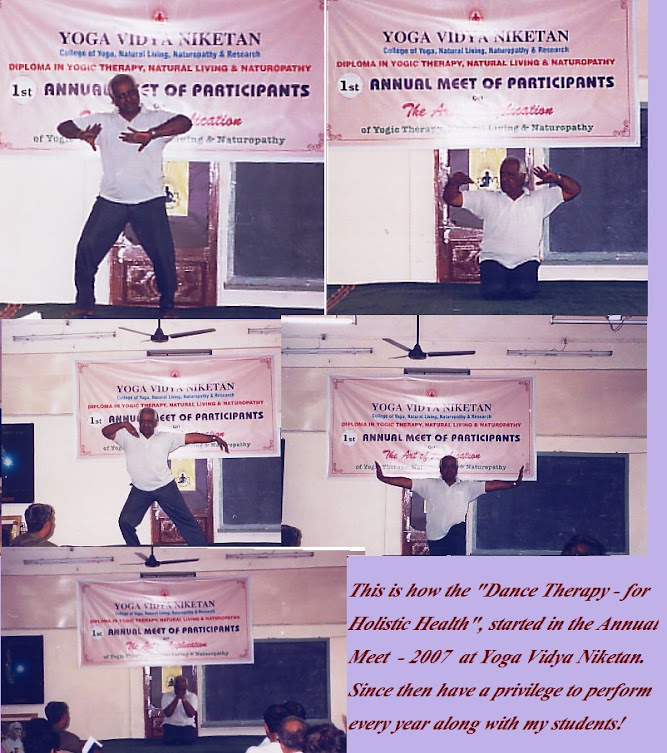
With good wishes of the YVN family, Dance Therapy was started in the Annual Meet of 2007. Since then many students have helped to grow and develop Dance Therapy as an approach towards Holistic Health. I find, ‘Dance Therapy’ as the most powerful, interesting, sustaining, and energizing total  health package, which would be very easy for everyone to have Holistic Health.
Exercise can be fun too. Try adding dancing to your fitness routine.
Dancing can be magical and transforming. It can breathe new life into a tired soul; make a spirit soar; unleash locked-away creativity; unite generations and cultures; inspire new activities; kindle inner strength; trigger long-forgotten memories, and turn sadness into joy, all these, only when we dance.
On a more physical level, dancing can give us a great mind-body workout. Researchers have found that regular physical activity can help us to keep our body, brain, and psyche healthy as we age old. Exercise increases the level of brain chemicals that energies nerve cells to grow. And in dancing, we require to remember steps, moves, and sequences and that boosts brain power and improves memory.
According to Rita BeckfordM.D., a family doctor and spokesperson for the American Council on Exercise, published in New England Journal of Medicine found that ballroom dancing at least twice a week made people less likely to develop dementia. Research also has shown that some people with Alzheimer's disease are able to recall forgotten memories when they dance to music they used to know.
It could be any form of dance, it helps people of all ages in physical abilities and stay in shape. There's even chair dancing for people with physical limitations. An obese adult can burn about 150 calories doing 30 minutes of moderate social dancing.
AYUSH, of GOI,  Yoga is Dance Therapy aimed to work on cleansing and strengthening the Pancha Koshas. In Dance Therapy we have taken musical numbers for working on each of the Koshas.
Since everything on Earth including our Sthula Sharira is from SUN, we start with a prayer to Sun then, bring coordination between brain and body, next energized the body system by deriving maximum oxygen through Aerobic movements and finally relaxed and submit to Supreme Power - the NATURE.
1.   Surya Beeja Mantra with Namaskar
2.   Next warming up and Brain Exercise to activate our brain cells, practices to Cope with Stress
3. Work out for Annamaya and Pranamaya Koshas starting with Standing aerobic exercises then on floor aerobic exercises to derive maximum oxygen to body parts
4. Work on mind and intellect – Manomaya and Vijnanamaya Koshas to understand the final destiny for this body is ABODE of Paramatma – using Kabir’s song
5.   Finally, try to be in Anandamaya Kosha and get merged with GOD and Nature. 


Brief on Dance Therapy 
Sun is ORIGIN of ALL - Pray Sun God -


Suryanamaskar Position V
Warming & Stretching - Veera Bhadrasana

To activate the Brain Cells -
Here Massaging Brain Buttons!
Brain Exercise for Coordinated Movements
COPE with STRESS with Tongue Lock
COPE with STRESS with Simha Mudra
to Drain all Tension
COPE with STRESS with Eye Movements
STRESS relief Eyes connecting Brain Cells


After Cool Mind at One Place, now Workout. Through Aerobic Movements to Get Maximum Oxygen to clean cells, repair tissues, strengthen organs & making systems efficient.

        
Next on Floor for All body parts & Joints


Now on Mind, Intellect and GOD with Kabir's Song
and Blissful Music


Thanks to our Guruji Padma Shri Nimbalkar
for Blessing and Gracing the occasion 

Benefits Abound

Like any other slow, moderate, low-impact, weight-bearing activities, such as brisk walking, swimming, cycling or aerobics, dancing can help:
  • strengthening the muscles without hurting your joints
  • empower the nerves
  • tone your entire body
  • improve posture and balance, which can prevent falls
  • increase endurance, stamina, and flexibility
  • reduce stress and tension
  • build confidence
  • provide opportunities to express our mind, and
  • ward off illnesses like diabetes, high blood pressure, heart disease, osteoporosis, and depression

Saturday, December 7, 2013

Science of spirituality

What is spirituality?

According to the scholars spirituality means: “intrinsically based beliefs in which personal values are used for guidance in day-to-day living”, “an article of faith; a spiritual the person possesses a right relationship with all that is”, “spirituality is what gives significance and purpose to one’s life”, etc., commonly people look upon the Spirituality as – Meditation, Connectedness, Mindfulness, Authenticity, Inner-health, Oneness, Self-centering, Relaxation, Self-discovery, Finding Purpose, etc.
About Yoga Therapy, our revered Sir Padma Shri Sadashiv Nimbalkar would say that we must know our body, mind, and soul then only any upachar or treatment could be possible. Taking this prime principle, I had the privilege to design the course for Naturopathy, when I was Coordinator. In this article, I wish to explore the finer aspect of human beings, spirituality as a topic for Yoga Therapy.
I was handling the topic ‘Maun’, for the Naturopathy course. I found, ‘Maun as a Tool for meditation’. Here, the techniques followed were to explore Tri-Sharira, Pancha-Kosha, and Chakras to reach the final state of Dhyana.
I feel spirituality is an ‘Anchor’ for the lifeboat that carries on a comfortable, smooth, happy, and safe voyage. Spirituality is the process through which integrates harmoniously the body, mind, intellect, and the soul and is able to connect to the Supreme Body, the Creator. We see, every religion, in one or the other way has advocated its followers to remain connected with the Creator of the universe. 
To be connected with Supreme Soul is known as Meditation. Patanjali has given the Meditation, the Dhyana as a part of Antaranga Yoga. The Ashtanga Yoga is divided into two parts. 1.Bahiranga Yoga: Yama, Niyama, Asana, and Pranayama, and 2. Antaranga Yoga: Dharana, Dhyana, and Samadhi. The connecting link between these two is Pratyahara. 
Pratyahara is the process of severe the mind’s connection with the external world and creating the distracting thoughts. Once, the mind is calm, it can be directed towards the inner self, our soul. Our mind would be now with our living Soul, which is ready to get united with the Supreme Soul. 
This uniting of TWO SOULS would be possible when we are able to fix our mind on the Union of Souls, and this process is called Dharana. When these SOULs remain united in the Blissful domain, is absolute the state of Dhyana, the Meditation. During Dhyana, when we totally assimilate with nature, this state is called Samadhi.
Today, there are many people who work in this area and also there are well-established institutions that are working to establish peace in society through meditation. The importance of meditation as a spiritual activity cannot be over-emphasized. Spirituality is the eternal and everlasting true form of every soul. If we live with clarity of mind, meditation is possible to get us to an awakened state. Meditation is an attitude. We are always with self, in this state, meaning we experience our true self; when we choose to be close to self that is the state of meditation.
How to do the Meditation?
To meditate, first we need to understand our inner resources and strengthen them. This can be done by way of strengthening and purifying the Koshas and the Chakras, the energy centers.
To strengthen Annamaya Kosha, we do physical activities and take nutritious healthy food. The Pranayama and breathing practices help us to empower Prnamaya Kosha. The next one, Manomaya Kosha, is related to the thought process, which is thinking. How to have control over this layer? How make it think positively?
From our toddler days we have been trained in basic necessities of life, like how to talk, how to walk or eat. Later, we had grown, we had a good education to become a qualified doctor, an engineer, a lawyer, a caterer, or any skilled professional.
At all the stages of our life we were trained only to live comfortably and successfully in the external world. We were never learned how to look within. To look within we need to think quietly with a calm mind and clear perception. We all know that our thoughts are shaped by the information we get through the sense organs. These thoughts make our understanding; our understanding makes our personality, finally shape our life.
To frame the thoughts, we need to think. It is, therefore, essential to learning to think , and equally it is essential to train our mind to think positively, which Gita does, it teaches us to cultivate a positive thinking process. This positive thought process paves the way to our intellectual sheath, the Vigyanamaya Kosha and the discriminative power of our intellect enable us to open the last and fifth layer, the blissful sheath, the Anandamaya Kosha. Here, we can feel our soul. We can now take the inner journey to reach the Supreme Power and be in a blissful state. This is the main purpose of meditation.
Techniques to get into Meditative State
We have been taught a breathing practice, Prana Dharana means the fixation of the mind on the breath; it is the first step to control the mind as such a step towards Meditation, as we start it, in few minutes we will start feeling changes inside. We will not make any effort to breathe, let it be natural. Just count it. Then feel its touch and go along it to know its path, finally, feel its temperature variations. We will find ourselves deep within our-self. Now, practice Sakshi Bhavana (Witness the emotions/thoughts), a practice to cleanse the mind (catharsis), in few moments we can feel unwanted thoughts and painful emotions are drained out of our mind. This will be the awaken state of our meditative nature. Slowly we will start feeling our life, we will feel energized and getting creative strength. 

At this point, we will concentrate upon Chakras one by one from Mooladhara, Swadisthan, Manipur, Anahat, and Vishuddhi and with yogic practices, these chakras will be cleansed. Finally, we may feel that Anjana (Agya) Chakra has been lighting up and may visualize the flame of Supreme Power there and meditate upon Him Omkara. While silent inner chanting of Om, Now, we may experience the Sahasra Chakra is slowly illuminating (The Brain Cells are empowered).
Science of Meditative State
The Universe is full of vibrations, called cosmic energy and it is spread across and pervaded all over the environment from the surface of the earth to the outermost layer of the Universe. When these vibrations touch our system, our system transforms them into thoughts, therefore, these are called power. We get the power to think and the power to create thoughts. We have not learned to use this power, as we don’t know to think to create power. What we are thinking is not thinking, it is just reflections of on what occurs to our mind.
If we knew how to think and what to think, we could create paradise. The power to think is the power of creation. We are, what we have created by our thoughts, it is this life. These are outcome of our thoughts, our imaginations, and our dreams. Whatever we imagine, we see, or we think, we feel they are the truth. If we consciously know how to use our thoughts, how to use our thinking power, then we would have made our lives as we want it to be.
All matter is energy from cosmic energy, our consciousness is energy, and with all the force it is our consciousness. Strength comes when we connected to cosmic vibrations, we are then positive, and feel healthy; on the other hand, when consciousness is weak, we are destructive, we start feeling different, and feel poor health. 

When our thoughts are healthy, positive, we start feeling strong. When our thoughts are negative, we start feeling weak. When we are sincere, we feel strong; when we are not, we start feeling very weak.
What I learned in Silva Mind Power training is that we get this cosmic energy while we are in deep sleep and this conscious energy is sufficient to carry out our day to day activities like to walk, to see, to eat, to sleep, etc., which is not sufficient to meet the challenges of a present-day hectic life. We can get a good amount of this cosmic energy through Meditation, Yoga Nidra, etc., where we awaken our conscious mind and energized it.
Let’s be Blissful
When we sit for meditation, let’s not do anything, no effort, mere presence, and be quiet with ourselves. Just present, feel the environment, the atmosphere, just enjoy our own company. Finally, let us learn to be with a meditative attitude, through watching the breath and slowly progressing to discover our inner Self, thereby nurture our life into a beautiful garden with lots of colourful flowers and pleasant fragrance. Wish you all a Blissful Meditation.


* Prof. K S Iyer, Freelance Professor, Yoga teacher, Yoga Therapist & Naturopath. Consultant for Health & Wealth and Yogic Lifestyle.