Monday, February 1, 2021

Why for Holistic Health Yogic Practices are Better than Physical Exercises?

Prof. K. S. Iyer*

Today, we see people are crowding at Gym and put long hours of workout. Are these people really know they healthy and well? Do these people enjoy Total Wellness? In a way, yes, but I have my own doubts, when I come across the report of religious Gym goers collapsed on the street while in the morning walk, while chasing the ball in the football player on the ground or while performing rigorous physical activity. No doubt, exercise is a component of Yogic way of living, the Vihar, one of the components of Yogic Lifestyle, i.e., Aahar – our diet, Vihar – Activities and the Nidra – our relaxation, (both in deep sleep when the brain waves are in delta stage or in Shavasana or in Yoga Nidra).
Yoga asana is a set of physical postures that are done in a systematic manner to ensure good health with the equilibrium of the mind, body, and, soul. Yoga asana should be performed following the principles given by Maharishi Patanjali along with the techniques detailed in Hatha Yoga literature, Hatha Yoga Pradipika by Swatmaram Suri is one of them.
Asana deals with the spiritual, mental, and physical aspects of the human life that the person is healthy not only from outside but also from the inner self. Yoga asana involves slow and steady movements integrating organs and mind with the smooth breath that will not make us exhausted. Instead, we feel refreshed and satisfied. The asana postures are classified into three categories:
Meditative asana: these are done during meditative practices.
Balancing asana: these help us in achieving peace and balance to the mind.
Strengthening asana: these help to enhance strength of muscles & nerves thus physical power.
Ø  Asana help in improving the balance, flexibility, strength, agility, vitality, and longevity of a person.
Ø  It helps in maintaining holistic health and managing various disorders.
Ø  Continuous practice of asana enables to regulate our breathing process, thereby enabling us to get maximum oxygen to our body to enhance its vital energy, cleaning the Pranamaya kosha and making it transparent and energized.
Ø  Improved breathing helps in getting maximum quantity of oxygenated blood, which enriches every cell of the body that every the tissue is repaired, every organ becomes strong and their functioning becomes most efficient. Every gland secretes the optimal hormone, the most improved circulatory system enables all the capillaries to carry blood smoothly and an unobstructed network of the nervous system communicates between the brain and the rest of the parts of the body.
The final outcome is holistic health with improved physical strength, good memory, absolute calmness, wellness, alertness, and achieves a positive attitude.
Yogic practices are for everyone there is no bar on age, sex, body condition, caste, or religion. Yet, to perform an asana in a traditional way we need a smooth, supple and flexible body. Our incorrect way of living for years has amassed layers of flesh all over the body, corrupted our mind and there is a complete disjoint between living and supreme bodies that spiritualism has reduced to rituals. To tune the body to derive the maximum benefits of Yoga Suryanamaskar and exercises are the most desirable form of activities.
Physical exercise is the activity of the body that deals with the physical fitness and physical growth & development of the body. This is done to develop muscles, improve physical skills, enhancing the immune system, managing body disorders like diabetes, cardiovascular problems, and reducing the weight in obese individuals and managing the ideal body weight.
There are three categories of exercise which enhance the flexibility, strength and endurance of the body parts, these are as follows:
Stretching exercise to improve flexibility and to tone the muscles;
Aerobic exercise to improve the endurance of respiratory and cardiovascular system
Strengthening exercise is Anaerobic and done to improve muscle & nerve strength.
Thus regular exercise burns calories and fat, helps in maintaining the right weight, improving the bone densities, and healthy the functioning of body parts.
To sum up, the Yoga asana are involved in improving the health of the body internally as well as externally. Physical exercise mostly does not involve the internal organs of the body in exercise. Energy expenditure occurs while performing physical exercise. In yoga, energy is not expended much while performing the asana. Hence the person does not feel tired.


*  Prof. K. S. Iyer, MPhil; MCom; BSc; BGL, PGDFM, CAIIB, PGP in C&A
Dip in YEd, Dip in Y.Th, ND (YVN) Diploma in Integrated Yoga Therapy (IYT, US), YIC (SVYASA)
AGM, RBI; Ex Prof cum Registrar ITM – IFM; Visiting Professor to DDE Madras University & JBMS, & IFSc Mumbai University since 1985.
Consultant, Om Shree Academy – A Centre for Yogic Lifestyle (Health & Wealth)

Saturday, September 28, 2019

Friday, September 27, 2019

Navaratri and Navavarna Kritis

Navaratri and Navavarna Kritis

Navaratri festival, a beautiful blend of art and culture commences on Amavasya in the month of Puratasi (Ashwini) is Sharada Navaratri: the most celebrated of the four Navaratri. Devi, who takes center stage for 10 days, is worshipped in several ways, music is one. Almost all the composers of Carnatic music have sung on Durga, Lakshmi, and Saraswati - Trisakti. 

It is Swati Tirunal Maharaja, who composed the Navaratri kritis, to be sung during these nine days. These kritis are rendered in their specific order at the concerts held at the Thiruvananthapuram Palace for Navaratri. He pleads 'Pahi mam'' (protect me) on behalf of all of us, to protect everyone, in these compositions.

The two most significant composers in this league are Muthuswami Dikshitar and Syama Sastri, the former being a Sri Vidya Upasaka and the latter a hereditary priest at the Bangaru Kamakshi Amman Temple, Thanjavur.

Dikshitar was initiated into Sri Vidya by Chidamabaranatha Yogi. His compositions on Devi contain Bijaksharas. His Navavaranam on Kamalamba is his significant contribution to the repertoire of Carnatic music. Being his birthplace, it is but natural that Dikshitar had a special attachment to Tiruvarur, especially to Kamalamba.

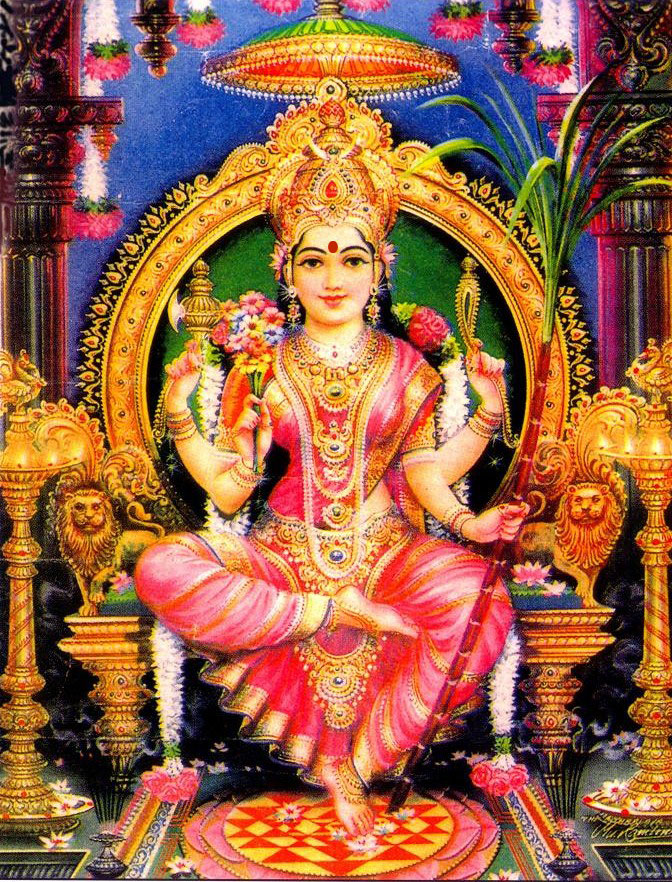
Worshipping Lalitha Parameswari in the form of Srichakra (the mystic Wheel) is considered the highest order of Devi Upasana.

The Wheel has nine enclosures and at the center is the Bindu. Dikshitar has composed nine kirtans, each having details of the Chakra and Avarana.

Majestic in style and composed in high-flown Sanskrit, the kritis reveal his profound knowledge in Mantra and Yantra Sastras. From the poetical and musical aspects, the tempo, the rhythm and above all, the fragrance of bhakti makes these compositions jewels that adorn Amba Parameswari. While Dikshitar's approach is intellectual, Syama Sastri's is like a child clinging to the mother for her attention. 

The tone of almost all of Syama Sastri's compositions is the same. He pleads to the Mother for her protection repeatedly (Brovavamma, Devi Brova, and Brova Samayamu). His Navaratnamalika, sung in Madurai, is a class by itself. His longing for Her glance is repeatedly revealed in his description of Her eyes like Sarojadalanetri, Meenanetri, Meenalochana, and Neelayatakshi. Among the Devi Kriti composers, he was fortunate to serve Kamakshi at her sanctum sanctorum. That moving experience is reflected in his compositions.

Oothukkadu Venkata Kavi, a pre-trinity composer, known for his scintillating compositions on Krishna, composed the Kamakshi Navavaranam. Here, the kritis, set to minor and anti ragas, are in the order of the Navavarana puja procedure. The use of different jatis in talas and change of the Kalai and Nadai are absolutely remarkable in the compositions. The use of Madhyamakala Sahitya is also complex and intricate.

All these composers have their own ways and styles of approach, but their voices unite in seeking Her benevolence and grace, celebrated across the country through this festival.
Muthuswami Dikshitar being a Sri Vidya Upasaka and the latter a hereditary priest at the Bangaru Kamakshi Amman Temple, Thanjavur. Dikshitar was initiated into Sri Vidya by Chidamabaranatha Yogi. His compositions on Devi contain Bijaksharas. His Navavaranam on Kamalamba is his significant contribution to the repertoire of Carnatic music. Being his birthplace, it is but natural that Dikshitar had a special attachment to Tiruvarur, especially to Kamalamba.

Worshipping Lalitha Parameswari in the form of Srichakra (the mystic Wheel) is considered the highest order of Devi Upasana. The Wheel has nine enclosures and at the center is the Bindu. Dikshitar has composed nine kirtans, each having details of the Chakra and Avarana. Majestic in style and composed in high-flown Sanskrit, the kritis reveal his profound knowledge in Mantra and Yantra Sastras. From the poetical and musical aspects, the tempo, the rhythm and above all, the fragrance of bhakti makes these compositions jewels that adorn Amba Parameswari.

All these composers have their own ways and styles of approach, but their voices unite in seeking Her benevolence and grace, celebrated across the country through this festival.

Here are Navavarna Kritis are set in praise of the Goddess Kamalamba who is enshrined in Tiruvarur in the Tanjore district of Tamil Nadu in South India. The Goddess is the reference to the Divine Mother of the Universe or the Supreme Consciousness. 
The lyrics and the descriptive details are loaded with the mystical symbolism of the Vedantic (Advaita) tradition and the chakras of the human system are closely linked to the evolutionary aspects described in the compositions that reflect the scholarly reach, musical depth and mystical significance of the composer. Navavarna refers to the 9 layers of the Sri Chakra yantra, one of the primary modes of Devi worship. Each avarna has a deity associated with it, which is mentioned in each of the songs.
Musically, they are par excellence and the majestic sweep of well-known ragas (melodic forms) like Todi, Kalyani, Kambhoji, Sankarabharanam, Sahana, Anandabhairavi, and Bhairavi are offset against haunting melodies in lesser-known ragas like Punnagavarali, Ghanta, and Ahiri.
Dikshitar uses several talas (time measures) although Rupakam (3 beats) seems to be his favorite. Ata talam (14 beats) and Misra Jampa (10 beats) in the Kambhoji and Bhairavi pieces are rarely used because of the technical difficulty in executing these. An added element is the use of different case endings (which Dikshitar uses in his other group krities like the Abhayamba and Nilotpalamba set). The Dhyana (invocatory) Kriti in Todi is in the vocative case, followed by the Anandabhairavi in the nominative, Kalyani in the accusative, Sankarabharanam in the instrumental, Kambhoji in the dative, Bhairavi in the ablative and so on. The ninth avarana Kriti in Ahiri has all the cases; the raga itself has all the 22 Sruti (notes) in the octave. It is believed that such a fusion of all melodic and temporal elements in the same Kriti is a musical way of expressing the advaitic ideal of "Aham Brahmasmi" or complete union with the Absolute. Indeed, the Ahiri composition is very unusual musically especially the Pallavi which has a repeating and distinctive prose section, is seamlessly put together.
The set concludes with a short and sweet Mangalam (auspicious conclusion) in Sri ragam set in Khanda Ekam (5 beat talam). The entire set consists therefore of the dhyanam (invocation), the nine avaranas, and the Mangalam (conclusion), a total of 11 pieces.

Kamalamba Navavarna Krithi)


Kamalaambike (Navavarnam: Dhyana Krithi)
Ragam: Thodi (8th melakarta)
ARO: S R1 G2 M1 P D1 N2 S ||
AVA: S N2 D1 P M1 G2 R1 S || Talam: Rupakam
Version: Bombay Sisters & Sita Rajan/MSS (Semmangudi version)
Composer: Muthuswami Dikshitar Sahitya & Meanings courtesy: www.sangeetham.com Pallavi
Kamaaneeya-Arunaam-Shuke Kara-Vidhruta-Shuke Maamava
Kamalaambike Ashrita Kalpalatike Chandike Anupallavi: Kamala-Aasana-Adi Poojita Kamalapade Bahu Varade
Sakala Loka Naayike Sangeeta Rasike Suka Vitva Pradaayike Sundari Gatamaayike
Kamala-Aalaya Teerttha Vaibhave Shive Karuna-Aarnave Charanam Vikalebara Muktidaana Nipune Agha-harane Viyadaadi Bhoota Kirane Vinoda Charane Arune
Kamalambika, You are the wish-fulfilling ("Ashita-Kalpa") creeper ("lathike") who protects those who surrender ("ashrita") unto You. You are of the form of Chandika, one of the ten aspects of Shakti known as Dasa Maha Vidya. You wear the beautiful ("kamaneeya") red ("Aruna") garment ("shuke"), representing rajo guna, necessary for the activities of the world (The Goddess it is, who conducts all the activities of the universe). You hold ("vidruta") the parrot ("shuka") in Your hand ("kara") thereby assuring devotees that you will destroy their ignorance. Pray, protect me ("maam-ava").
Sakale Guru Guhakarane Sadaa Shivaanta: Karane Akachata-tapaadi Varne Akhandaika-Rasa Purne Meanings: (from www.sangeetham.com)
Brahma ("Kamala-asana") and other ("aadi") Gods worship ("poojita") Your Lotus ("Kamala") Feet ("pade"). You grant a variety ("bahu") of boons ("varade"). You are enshrined ("aalaya") in all your grandeur ("vaibhava") on the Kamalaya Tirtha and have bestowed incomparable glory on it (and the town of Tiruvarur). You are always auspicious ("shive") (alternatively-You are the consort of Lord Siva) and the ocean ("aarnave") of compassion ("karuna").
You are the Ruler ("naayike") of the universe ("Sakala Loka"). You are of the form of the melody ("rasike") in music ("san-Geeta") (You appreciate the aspirant who has reached a stage where the melody of the Heart comes out in the form known as Anahata shabdA, the perennial sound). You bestow ("pra-daayike") poetic ("suka") ability ("vitva") (Here, it may be noted that most of the ancient scriptures and sastras are in poetic form). You are the beautiful One ("Sundari") who causes ("gata") delusion ("maayike") but who are Yourself not deluded. You remove ("mukti-daana nipune") the worst sin ("vikalebara") of man, that of identifying himself with his body ("agha-harane"), thereby granting ("mukti-daana") vidEha mukti. You are the One from whom the Panchabhutas ("bhoota") beginning ("aadi") with Akasa ("viya"), emanate ("kirane"). The glory ("vinoda") of Your Holy Feet ("charane") that grants the Highest Bliss is marvelous and indescribable. You shine brilliantly in red ("arune"). You are the One who is the All ("sakale"), the One who manifests in all degrees of power from the lowest to the highest. You were instrumental in giving birth ("karane") to Lord Subrahmanya ("guruguha"). You are ("karane") the Heart ("antah") of Lord Siva ("sadaashiva"), therefore, verily, the Supreme Truth itself (You are the Fundamental Cause, the Supreme Truth that shines in the Heart Cave). You are the very embodiment ("varne") of the 50 letters ("a-ka-cha-ta-tapa-aadi") that form the root for all mantras. You are the One who is ever full ("purne") of that Boundless, Indivisible, Perennial ("akhanda-eka") Bliss ("rasa"). Oh, Mother of the universe, pray, protect me!
kamanIyAruNAm shukE: The Goddess dons the beautiful red garment. Red represents rajO guNA which is necessary for conducting the activities of the world. karavidhruta shukE: One who holds the parrot in her hand. The parrot represents the jIvA that is enmeshed in ignorance. The esoteric meaning is that, the Goddess creates the ignorance as well as frees the jIvA, the individual from ignorance. Hence, She symbolically holds the parrot in her hand. karunArNavE: Ocean of Compassion gata mAyikE: The Goddess causes the delusion and ignorance through Her Maya, yet, She Herself does not suffer from delusion, for She is the Supreme Self. vikaLEbara mukti: There are two kinds of mukti, jIvan mukti and vidEha mukti. A person who has realised the Self while in the body is a jIvan muktA. vidEha mukti is the transcendental state of Perfection obtained after a jIvan muktA leaves his body. But, for a jnAni, there is no difference between the two. Here, the esoteric meaning is that, the Goddess removes the ignorance of man who identifies himself with his body and thus suffers. She grants the boon of jnAnA and mOkshA that results in the destruction of the ego and the non-identification of the Self with the body.
agha haraNE: The One who

Sunday, July 9, 2017

The Science of Pranyama!

OUR LIFE SPAN IS ONE BREATH - WE STARTED OUR LIFE WITH THE FIRST INHALATION CRYING LOUDLY & ONE DAY WE WILL FINALLY BREATHE OUT END OUR LIFE. OUR GAME OF LIFE DEPENDS ON HOW FARTHEST WE CAN PUSH THAT LAST EXHALATION? 

IT'S POSSIBLE BY ADOPTING DISCIPLINED BREATHING PRACTICE! 
How, one may ask?
All we need to do is to understand the importance of Pranayama, the process of disciplined, controlled and conscious breathing.
The word Pranayama is made of two syllables - Prana and Ayam - Breath when it is converted into oxygenated breath it is called Prana Vayu in the heart - from there this blood travels through the arteries to various parts of the body - the one going towards head is Udana Vayu, that travels towards lower extremities is called Apana Vayu, the one transverses around the thoracic region is called Samana Vayu thus the envelop of the oxygenated blood in every cell is called Vyana Vayu. All these, Pancha Maha Prana, together form the Vital Energy Sheath (Pranamaya Kosha).
The oxygenated blood (through internal respiration) removes toxin from every cell and becomes impure, the venous blood that after circulation reaches the heart, pumped into lungs and absorbs the oxygen from the breath, inhaled once again get purified as oxygenated blood, that is pumped back to the heart thereby completing the Circulation of the Circulatory System.
The Circulatory System not only removes toxin from the cells but also repairs the cells in turn repairs the tissues (the group of cells) - these healthy tissues make the organs healthy and these organs function efficiently and efficiently that the organs become healthy and make the person free from diseases, and ailments. 
Conscious deep breathing can give us about 6 to 8 percent oxygen, which 20% in nature. However, regular practice of Pranayama can give us 12% to 15% of Oxygen, thereby prevent all serious ailments.
There is a misconception about pranayama that Anulom - Vilom, Kapalbhati are pranayama. Anulom - Vilom, is breathing practice, called Nadi Shodhana - as this practice cleans the three major nadis - Pingala (Surya Nadi), Ida (Chandra Nadi) and the Sushumna Nadi that starts from Bhruguti (the point between eyebrows) and passes through spinal cord, when done along with Tr--Maha Bandha, it is called Nadi Shodhana Pranayama. 
The Kapalbhati is one of the Shath Kriya (the first component of Hatha Yoga for Cleaning Body organs) cleans the network 0f nervous system starts from naval (Solar Plexus) carrying the signals and make the flow of vital energy through the Nadis are smooth to brain cells uninterrupted, thereby, makes our face radiant. So, the practice is called Kapalbhati (Kapal means forehead and Bhati means radiating).
We must not mistake breathing practices as pranayama - unless we apply Tri-Maha-bandha (three major locks) it is just breathing practice not Pranayama. 
The three bandhas are Moola Bandha (contracting anus sphincter and hold it tight all through the pranayama), Moola Bandha tightens entire large intestine and stomach and pushes up the diaphragm from bottom. Breathing in is Poorak, slowly gradually take full breath filling lungs, next apply Jalandhar Bandha (bending head down closing the seven passages through the throat, then fixing firmly the chin at jugular notch) and finally apply Uddiyana Bandha (here we have to pull up the diaphragm and hold tight). By this process we put pressure on the lungs from all the sides, which is filled in with breath. During this period, the heart pumps the blood into lungs. e to this pressure on the lungs, pumped blood absorbs maximum amount of oxygen from the breath that contains 20% of oxygen.
If we notice the mechanism of pranayama - we will understand that the breath in the lungs is subjected to pressure from all the sides. When the pressure or temperature is increased the chemical action is also increased, thus blood could absorb maximum amount of oxygen, up to 12 to 15 percent of Oxygen, the presence of water vapour, inert gases and nitrogen along with Oxygen, by nature is combustible, becomes useful and gives life.
When we are angry, excited, or worried, either we forget to breathe or take shallow breath, that is rapid throat breath (kantha shwas) - breath doesn't reach lungs, and the impure blood pumped by heart would go back to heart without being cleaned, it is as good as allowing the same oil to circulate in the engine again and again till it is filled with all dirt - such impure blood with all toxins in circulation causes all sorts of ailment.
When we breathe consciously allowing breath to reach lungs and remain there for few seconds, then blood may be able to absorb about 5% to 8% of oxygen, by breathing practices blood can absorb up to 10% of oxygen and when we do pranayama applying tri-Maha-bandhas then we can absorb maximum amount of oxygen say up to 15% of oxygen.
The above one is the major benefit of practicing Pranayama.
Spiritually, Pranayama has a very important step in mastering the mind and enable us to get to state of meditation.
In the Ashtanga Yoga of Maharishi Patanjali, Pranayama is fourth and last Anga (Part) of Bahiranga (external) Yoga: the Yama the rules for society (Don'ts), next is the Niyama the rules (Dos) for every individual, next is Asana for tuning physical body, enhancing endurance that we can hold meditative posture for a long time and the fourth one is Pranayama besides giving body good amount of oxygenated blood, SOURCE FOR VITAL ENERGY, PRANA, the pranayama also helps in fixing mind at one point (concentration) and this happens, when we fix our mind on breath (the process is called PRANA DHARANA that is fix the mind on the breath, we may find it is easy to control mind.
Next Anga (limb) of Ashtanga Yoga is Pratyahara that connects Bahiranga Yoga to Antaranga Yoga.

Mind is connected to outer world through the senses, five input devices to mind that give all sorts of information to mind. The information received by mind trigger thoughts that cause emotions. Mind is thus subjected to fluctuations, modification, and restless.

Till, the input devices of mind are not closed down, the senses will be in contact with external world, we would not be able to direct mind towards inner consciousness, and the Soul. The process of closing down the senses and mind moves towards inner consciousness, is called Pratyahara.
Now we may fix the mind on an object, image of God or Om (ॐ) or on any sound, or chanting omkar very gently, the mind slowly gets into state of absolute peace. The breathing slows down, at times we may not breathe this is the Dharana (concentration). 
Slowly, Soul becomes one with Divine Source, in an absolute peace, in an emancipated state it is Dhyana (Meditation) inner consciousness silently feel the vibrations of NATURE, slowly assimilates with the Universal Soul. It is the state of Samadhi in state of salvation.
Om Tat Sat!

Friday, June 20, 2014

Wellness & Holistic Health Management

How well are you?

When someone asks, How do you do?", we may not think even for a moment and say all fine. 

Later, when we think about what we said then we may realize that things are not all that well. Wellness, if we seriously look into its various aspects of ourselves, then we may see that it is not just one aspect but encompasses different aspects of ourselves physical, mental, emotional, intellectual, social, financial, spiritual and family? 


In order to understand our wellness, we  need to know all above components that make us well. Even when one of these factor is not good, we will be disturbed. When we know the factor, soon, we can take remedial step. This would be possible only through alert INTELLECT that controls the mind. Then it seems possible to have a Holistic WELLNESS!

When I say about the alertness, following experiences flash back:
  • At times I show my office ID card instead of taking out the key to unlock the house door!
  • We with family went out for dinner in one of the best restaurants. And finished, I started walking towards the wash basin with Plates in my hand..!
  • I don’t login and use Facebook, YouTube, yahoo, Gmail, etc., in my personal computer at home… thinking these are blocked any way. Till I realize – I am at home..!
  • At times at home, I keep my hands in front of tap waiting for water to come by itself and it's very frequent with me. I just forget we have to turn on and off the tap at home.
  • Once after talking to one of my friends I ended the conversation saying, "OK bye…in case of any issues will call you back"
  • By mistake when I delete a message from mobile, I hope for few seconds that it’s in recycle bin!
  • Once I went to a pharmacy and asked for a tab….pharmacist asked me, whether I want 250 mg or 500 mg….. I replied 256 MB …. thank god he didn’t notice..!
  • And I – after a hectic week, went to a movie. In the middle of the movie, when I wanted to check the time, I kept repeatedly glancing at the bottom right corner of the screen in the Theater 
Why such things keep happening to us, that's due to the sensors of our alertness have slowed down. 

These symptoms are commonly seen in the people, whose burnt out level is too high - their lifestyle needs immediate attention, as they have totally forgotten to relax, mind is always in hyper beta (Beta brain waves occur between 14 - 30 Hz but during intense mental activity can reach 50 Hz i.e., Beta waves characterize the conscious waking state at 14 cycles per second and up). This state of brain waves while we are active.
During alpha (Alpha brain waves occur between 8 - 13 Hz i.e., the alpha state operates at a lower cycle, 7-14 cycles per second level. In general, the alpha rhythm is the prominent EEG wave pattern of an adult who is awake but relaxed with eyes closed). This state of brain waves early morning when we get up from sleep. 
In delta (Delta brainwaves occur below 3.5 Hz i.e., brain wave activity in the delta state ranges from 0 - 4 cycles per second. This is total unconsciousness, deep, dreamless sleep. When we are asleep and not dreaming, the brain generates delta waves). This state of brain waves when are in deep sleep.
This state helps to derive the necessary energy to not only to make our day's activities easily possible but also helps to repair the cells and tissues thereby the weaker organs efficient, which otherwise would succumb to every small additional pressure and fails to work efficiently.

Now let’s see what's the degree of our burnout level?


For each question, tick the cell in the column that most applies to you against every question in a row:

#
Question
Not
at all
Rarely
Some
times
Often
Very
Often
1
Do you feel run down and drained of physical or emotional energy?


2
Do you find that you are prone to negative thinking about your job?


3
Do you find that you are harder and less sympathetic with people than perhaps they deserve?


4
Do you find yourself getting easily irritated by small problems, or by your co-workers and team?


5
Do you feel misunderstood or unappreciated by your co-workers?


6
Do you feel that you have no one to talk to?


7
Do you feel that you are achieving less than you should?


8
Do you feel under an unpleasant level of pressure to succeed?


9
Do you feel that you are not getting what you want out of your job?


10
Do you feel that you are in the wrong organization or the wrong profession?


11
Are you becoming frustrated with parts of your job?


12
Do you feel that organizational politics or bureaucracy frustrate your ability to do a good job?


13
Do you feel that there is more work to do than you practically have the ability to do?


14
Do you feel that you do not have time to do many of the things that are important to doing a good quality job?


15
Do you find that you do not have time to plan as much as you would like to?


Total Ticks
C1X 1
C2X  2
C3X 3
C4X 4
C5X 5

Total of Weighted Scores Total = 


Checking Yourself for Burnout Total ticks of each column C1, C2, C3, C4 & C5 and multiply these numbers with 1, 2, 3, 4, & 5 respectively and add the products thereof, the sum is the Weighted Scores Total.

Your score is:
Score Interpretation to test your Level of Burn Out.
Score
Comment
15 – 18
Little sign of burnout here
19 – 32
Little sign of burnout here, unless some factors are particularly severe
33 – 49
Be careful - you may be at risk of burnout, particularly if several scores are high
50 – 59
You may be at severe risk of burnout - do something about this urgently
60 - 75
You may be at very severe risk of burnout - do something about this urgently

This is my introductory talk, while handling the topic, "Manage Yourself to Cope with Stress" for the course Diploma in Yoga Therapy, Natural Living and Naturopathy for Yoga Vidya Niketan.

Monday, February 17, 2014

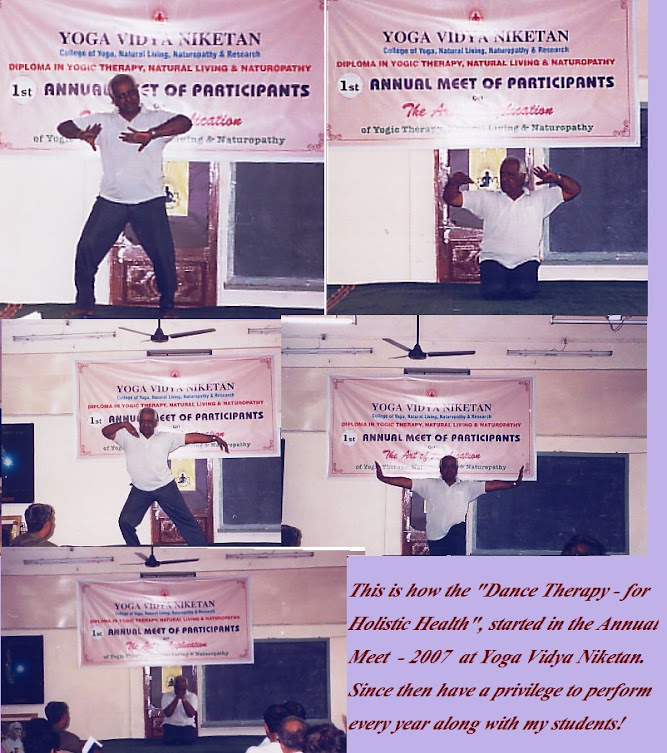
Dance Your Way To Health - 2014

With good wishes of the YVN family, Dance Therapy was started in the Annual Meet of 2007. Since then many students have helped to grow and develop Dance Therapy as an approach towards Holistic Health. I find, ‘Dance Therapy’ as the most powerful, interesting, sustaining, and energizing total  health package, which would be very easy for everyone to have Holistic Health.
Exercise can be fun too. Try adding dancing to your fitness routine.
Dancing can be magical and transforming. It can breathe new life into a tired soul; make a spirit soar; unleash locked-away creativity; unite generations and cultures; inspire new activities; kindle inner strength; trigger long-forgotten memories, and turn sadness into joy, all these, only when we dance.
On a more physical level, dancing can give us a great mind-body workout. Researchers have found that regular physical activity can help us to keep our body, brain, and psyche healthy as we age old. Exercise increases the level of brain chemicals that energies nerve cells to grow. And in dancing, we require to remember steps, moves, and sequences and that boosts brain power and improves memory.
According to Rita BeckfordM.D., a family doctor and spokesperson for the American Council on Exercise, published in New England Journal of Medicine found that ballroom dancing at least twice a week made people less likely to develop dementia. Research also has shown that some people with Alzheimer's disease are able to recall forgotten memories when they dance to music they used to know.
It could be any form of dance, it helps people of all ages in physical abilities and stay in shape. There's even chair dancing for people with physical limitations. An obese adult can burn about 150 calories doing 30 minutes of moderate social dancing.
AYUSH, of GOI,  Yoga is Dance Therapy aimed to work on cleansing and strengthening the Pancha Koshas. In Dance Therapy we have taken musical numbers for working on each of the Koshas.
Since everything on Earth including our Sthula Sharira is from SUN, we start with a prayer to Sun then, bring coordination between brain and body, next energized the body system by deriving maximum oxygen through Aerobic movements and finally relaxed and submit to Supreme Power - the NATURE.
1.   Surya Beeja Mantra with Namaskar
2.   Next warming up and Brain Exercise to activate our brain cells, practices to Cope with Stress
3. Work out for Annamaya and Pranamaya Koshas starting with Standing aerobic exercises then on floor aerobic exercises to derive maximum oxygen to body parts
4. Work on mind and intellect – Manomaya and Vijnanamaya Koshas to understand the final destiny for this body is ABODE of Paramatma – using Kabir’s song
5.   Finally, try to be in Anandamaya Kosha and get merged with GOD and Nature. 


Brief on Dance Therapy 
Sun is ORIGIN of ALL - Pray Sun God -


Suryanamaskar Position V
Warming & Stretching - Veera Bhadrasana

To activate the Brain Cells -
Here Massaging Brain Buttons!
Brain Exercise for Coordinated Movements
COPE with STRESS with Tongue Lock
COPE with STRESS with Simha Mudra
to Drain all Tension
COPE with STRESS with Eye Movements
STRESS relief Eyes connecting Brain Cells


After Cool Mind at One Place, now Workout. Through Aerobic Movements to Get Maximum Oxygen to clean cells, repair tissues, strengthen organs & making systems efficient.

        
Next on Floor for All body parts & Joints


Now on Mind, Intellect and GOD with Kabir's Song
and Blissful Music


Thanks to our Guruji Padma Shri Nimbalkar
for Blessing and Gracing the occasion 

Benefits Abound

Like any other slow, moderate, low-impact, weight-bearing activities, such as brisk walking, swimming, cycling or aerobics, dancing can help:
  • strengthening the muscles without hurting your joints
  • empower the nerves
  • tone your entire body
  • improve posture and balance, which can prevent falls
  • increase endurance, stamina, and flexibility
  • reduce stress and tension
  • build confidence
  • provide opportunities to express our mind, and
  • ward off illnesses like diabetes, high blood pressure, heart disease, osteoporosis, and depression